Best Net Worth Trackers for Crypto Investors in 2026
Five active net worth trackers compared for multiple crypto wallets, DeFi, exchanges, banks, property, liabilities, history, and privacy.
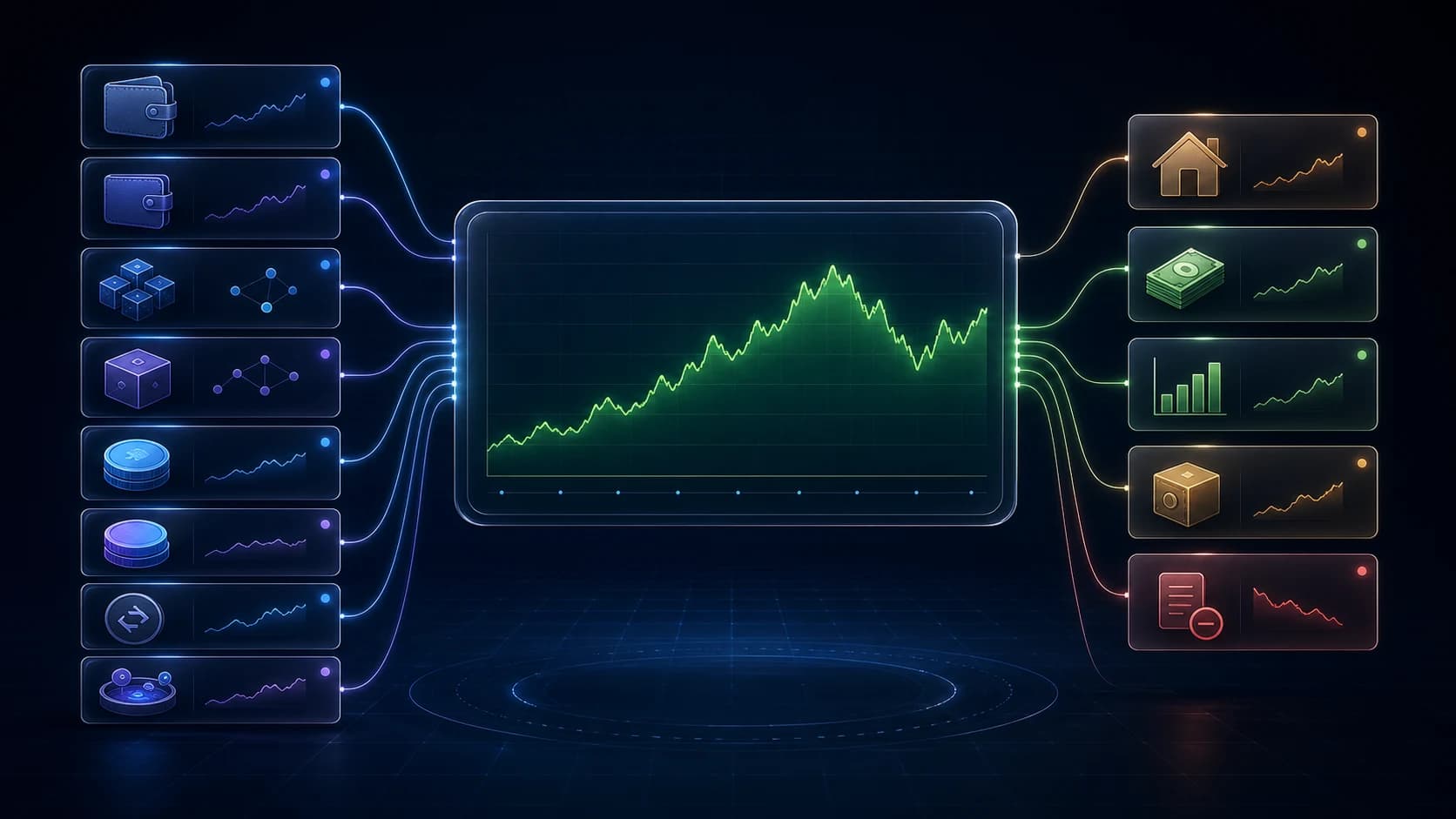
Monarch includes Coinbase assets in net worth, but excludes funds Coinbase reports as loaned, borrowed, or used as collateral. TrackMyStack updates crypto prices without reading a wallet. Kubera documents more than 20 crypto exchange and wallet connections plus 16 named blockchains. Those differences matter when BTC, a Solana wallet, an Ethereum LP, property, cash, and a mortgage all need to produce one number.
Five active products met the criteria for this comparison. Each can track crypto alongside at least some assets outside crypto, maintain a net worth or portfolio history, and be used today. The products solve the job in markedly different ways.
Disclosure: UpdraftFi publishes this comparison and appears in it. Product details were checked against official product, help, pricing, and security pages on August 5, 2026. Sources are listed at the bottom.
By Phil, founder and developer of UpdraftFi.
The short answer
| Tracker | Best fit | How crypto gets in | Assets outside crypto | Current listed price | Main limitation |
|---|---|---|---|---|---|
| UpdraftFi | Portfolios spread across multiple wallets, chains, exchanges, and DeFi | Public wallet addresses and read-only exchange connections | Manual assets and liabilities | 7-day trial; $19 or $49 monthly, $190 or $490 annually | No automatic bank sync or finished tax reports |
| Kubera | Automated tracking across banks, brokerages, crypto, private assets, and property | 20-plus exchange and wallet connections, 16 named blockchains, hardware wallets, and supported DeFi | Broad automatic connections, tickers, and appraisals | $250/year; Black is $2,500/year | Documented DeFi examples focus on Ethereum, BSC, and Polygon |
| Monarch | Household finances, budgets, cash flow, and net worth with some crypto | Coinbase connection or manual holdings | 13,000-plus financial institutions, manual accounts, and Zillow property values | $99.99/year or $14.99/month after a 7-day trial | Little support for self-custody wallets and DeFi |
| TrackMyStack | Private manual tracking without linked financial accounts | Holdings entered manually, with automatic market prices | Manual assets and liabilities | Free; Premium is $4/month or $30/year on its website | No wallet, exchange, bank, or brokerage connections |
| Manalyx | A low-cost, manual-first mix of crypto and real assets | Wallet import across 12 blockchains, read-only exchanges, and supported DeFi | Manual assets plus document or statement imports | Free; Premium is €3.99/month | The product is still presented as a beta |
UpdraftFi is the strongest fit in this comparison for a crypto investor with several EVM wallets and active DeFi positions. A Kubera subscription can save substantial manual work when banks, brokerages, private assets, and relatively simple crypto holdings make up most of the balance sheet. A household that wants categorized transactions and a monthly budget should consider Monarch.
How the products qualified
A balance checker that stops at public wallets did not qualify. Neither did a budgeting app that represents every crypto position as one manually updated number.
The shortlist required:
- An active product available to use on the check date
- Crypto support beyond a decorative asset category
- Assets or liabilities outside crypto
- A total net worth or portfolio history
- Public documentation detailed enough to verify how the product works
We compared the workflow that creates the total. Feature counts had little weight. In particular, we checked whether wallets and banks connect automatically, whether DeFi positions are recognized, how manual assets behave, what history is retained, who can decrypt stored data, and how pricing changes for larger portfolios.
UpdraftFi is strongest for multi-wallet EVM and DeFi
UpdraftFi was built by a DeFi native for investors whose crypto extends far beyond holding ETH on an exchange.
A representative UpdraftFi user may have four EVM addresses, native BTC in cold storage, a Solana wallet, assets on Kraken, and a mortgage. Public addresses and supported exchange connections update the crypto side. Cash, brokerage balances, property, businesses, vehicles, and liabilities are entered manually.
UpdraftFi covers more than 50 EVM chains, native Bitcoin, and Solana. Supported EVM positions include DeFi and NFTs. Bitcoin and Solana coverage is currently focused on on-chain balances, so readers should test their important positions rather than assume that every protocol on each network is decoded.
The EVM depth is the important part of that coverage. An address can hold a lending position, LP, vault, staking receipt, reward balance, and debt on several networks at once. UpdraftFi is built around discovering those positions and keeping them inside the same portfolio total. Its EVM integration layer is actively developed, so a missing protocol or unusual position can be investigated and added without imposing a fixed DeFi-chain boundary on the product.
No tracker can promise that every new protocol will decode correctly on day one. UpdraftFi gives EVM coverage the highest product priority. The team treats unsupported EVM positions as concrete integration work and prioritizes adding the protocols its users actually hold.
History is the central product. Paid plans save a daily snapshot while the user is offline. A transfer between two owned wallets remains visible inside the same dated net worth record. For supported yield-bearing positions, snapshots and cash flows are also used to calculate cumulative yield and realized APR for a selected period.
That calculation answers a question a current APY cannot. Depositing midway through the month, adding collateral, withdrawing rewards, and holding through a rate change all affect the return actually earned.
The privacy boundary needs a precise explanation. Stored balance history, encrypted backups, and portfolio data synced between devices use keys that UpdraftFi cannot recover. Scheduled updates still need wallet addresses and read-only exchange credentials. Those operational records use server-managed encryption and can be decrypted by the automated system. The local IndexedDB working copy relies on the device lock and browser profile and is unencrypted.
Basic costs $19 per month or $190 per year and includes 10 on-chain wallets, unlimited virtual wallets, and daily snapshots. Pro costs $49 per month or $490 per year and raises the on-chain wallet limit to 30. Both begin with a seven-day trial that does not require a card.
The manual bank and brokerage workflow will decide whether those prices make sense. Kubera and Monarch cover automatic checking, credit card, and brokerage updates. UpdraftFi is the better tracker for the audience considered here: people whose difficult tracking work comes from complex EVM and DeFi positions and who can update slow-moving traditional assets by hand.
Read more about UpdraftFi's crypto coverage, security boundaries, and pricing.
Kubera handles the broadest automated balance sheet
Kubera has stronger crypto coverage than many general wealth products. Its current help center lists Ethereum, Bitcoin, BSC, Polygon, Solana, Terra, Avalanche, Arbitrum, Optimism, Cosmos, Ripple, Bitcoin Cash, Dogecoin, Litecoin, Stellar, Tezos, and Cardano. Another current page lists connections to more than 20 exchanges and wallets, including hardware wallets. Its DeFi guide documents Maker vaults, Uniswap LPs, and multi-chain support including Ethereum, BSC, and Polygon. That is useful coverage for a broad wealth product.
The blockchain list and DeFi list describe different levels of support. Connecting an Arbitrum or Optimism address establishes wallet coverage, while Kubera's public DeFi documentation names Ethereum, BSC, and Polygon. Someone who mainly holds ETH, BTC, SOL, exchange balances, and a few established positions may be well served. A portfolio spread across lending markets, LPs, vaults, and newer protocols on several EVM networks should be tested position by position.
Banks and brokerages are where Kubera separates itself. It uses several financial aggregators and connects to thousands of institutions. Global stock, ETF, and mutual fund tickers can update automatically. Private investments, real estate, vehicles, precious metals, jewelry, and other assets can be added to the same balance sheet. Current product pages also describe automated appraisals and IRR calculations for private investments.
Essentials costs $250 per year. Kubera Black costs $2,500 per year and adds nested portfolios for trusts, companies, and family structures, granular access control, guided onboarding, and higher-touch support. Its Dead Man's Switch can send an archive of account data and documents to an emergency contact after repeated inactivity checks go unanswered.
Kubera states plainly that its data is encrypted at rest and in transit and is not end-to-end encrypted. Provider access is required in part so the Dead Man's Switch can create a readable archive. That design supports a feature UpdraftFi does not have, while giving Kubera the technical ability to decrypt customer financial records under its controls.
Kubera deserves credit for bringing wallets, exchanges, selected DeFi, banks, brokerages, private assets, property, and estate continuity into one product. UpdraftFi goes further for EVM portfolios: broader EVM coverage, deeper attention to protocol positions, faster adaptation when a position needs support, multi-wallet history, and realized yield for supported positions. That makes UpdraftFi the better choice for the crypto-heavy investor in this article. Kubera still makes sense when automatic conventional-finance aggregation and estate features carry more weight than DeFi depth.
See the detailed Kubera and UpdraftFi comparison.
Monarch makes sense when the household comes first
Monarch starts with accounts and transactions. Connect checking, savings, credit cards, loans, investments, and property, then use the same data for budgets, goals, cash-flow reports, and household collaboration. Its help center lists support for more than 13,000 financial institutions, while manual accounts cover assets that cannot connect.
Crypto support is narrower. Coinbase assets can flow into the net worth total, and recognized crypto can be entered as a manual holding with market prices. Monarch says its Coinbase calculation includes wallets, vaults, staked funds, multisig wallets or vaults, and DeFi yield accounts reported through that connection. Assets reported as loaned, borrowed, or collateral are excluded from the total.
Monarch does not document a general public-address workflow for Bitcoin, Solana, or EVM wallets. A person holding crypto across self-custody addresses would need manual holdings or a separate crypto tracker. Its investment performance also depends on the holdings and history received from each institution. When purchase dates or cost basis are unavailable, Monarch models performance as though the current securities were held for the entire selected period.
Core costs $99.99 per year or $14.99 per month after a seven-day trial with a payment method. That includes much more than net worth tracking. Someone who will use the budget, recurring transaction, goal, and household features gets a coherent personal finance product for less than either UpdraftFi Basic or Kubera Essentials.
Monarch wins when Coinbase is the main crypto account and daily household money management matters. Several self-custody wallets, protocol positions, and on-chain borrowing create too much manual upkeep.
TrackMyStack keeps financial connections out of the workflow
TrackMyStack asks the user to enter holdings rather than connect banks, brokerages, exchanges, or wallets. It then updates supported stock, ETF, and crypto prices. Cash, cards, loans, property, and other manual assets roll into the same net worth total. Portfolios can use different currencies, including BTC and ETH, and historical charts show changes over time.
This approach has two practical advantages. There are no bank credentials or exchange API keys to share, and unsupported assets can still be represented without waiting for an integration. It also creates regular maintenance. A BTC purchase, an ETH withdrawal, or a mortgage payment changes a quantity or balance that the user must update.
The free plan includes unlimited assets and portfolios, end-of-day market prices, dividend history, import and export, device protection, and account syncing. The website lists Premium at $4 per month or $30 per year, adding real-time prices, upcoming dividends, a retirement estimate, and priority support. Prices in mobile app stores can differ.
TrackMyStack says the portfolio stays on the device and provides encrypted syncing. Its public material does not offer the same cryptographic detail as UpdraftFi's security page, so the products should not be described as having identical security architectures without further evidence.
TrackMyStack is the strongest option here for someone who refuses financial account connections and is willing to maintain quantities manually. It also has the most capable free plan in this shortlist. Frequent traders and users with changing DeFi positions will spend too much time keeping it accurate.
Manalyx is the interesting beta
Manalyx comes closest to UpdraftFi's combination of crypto depth and real assets. Its current product page lists wallet imports across 12 blockchains, including Bitcoin, Ethereum, and Solana, along with supported DeFi positions and read-only exchange connections. Stocks, ETFs, property, precious metals, watches, vehicles, NFTs, cash, and debt feed the same total.
The workflow is manual-first. Stocks can be imported from broker documents, banks from statements, and many physical assets by entering their details. The product says sensitive API secrets and IBANs are encrypted at rest, and it does not run advertising trackers inside the app or sell user data.
The price is unusually low. Its free plan allows up to 10 manual assets and one exchange connection. Premium is listed at €3.99 per month with unlimited assets, exchange connections, bank statement imports, budgets, and alerts.
Manalyx still labels the product as a beta. That matters for a financial record expected to last for years. Prospective users should test data export, historical continuity, the exact protocols holding their assets, support responsiveness, and the handling of deleted or renamed connections before moving their only record there.
For someone comfortable trying a young product, Manalyx offers an ambitious set of asset types for very little money. UpdraftFi has broader documented EVM coverage and a more explicit zero-knowledge history model. Kubera has more mature financial aggregation and estate features. Manalyx's low price makes it worth watching as those gaps close.
Why Delta and Net Worth Track are outside the shortlist
Delta is active and useful. It connects wallets, exchanges, and stock brokers, tracks portfolio value and cash flow over time, and offers a capable mobile app. Its documented job is investment tracking across crypto, stocks, ETFs, funds, and related assets. The current product material does not establish comparable coverage for property, cash accounts, and liabilities, so it falls short of the complete net worth definition used here.
Net Worth Track describes almost exactly the product this audience wants: EVM, Solana, Bitcoin, centralized exchanges, Plaid, traditional assets, nested groups, and P&L. Its public page still asks visitors to join a waitlist and says the beta will launch in Q1 2026. That launch window has passed. Promised features and early-adopter prices cannot support a recommendation until the product is available to test.
Portmone is also worth watching. Its site advertises a free multi-portfolio tracker with daily snapshots, manual property and cash accounts, stocks, crypto, backtesting, and allocation tools. Current public documentation does not explain the wallet connection workflow, supported chains, security architecture, or long-term pricing in enough detail for this comparison.
Pick based on the part you will otherwise update by hand
Choose UpdraftFi when wallets, chains, exchanges, and DeFi create most of the tracking work, while property and conventional accounts can be updated manually. Its deep EVM coverage, active position-integration work, historical snapshots, and realized-yield calculations make it the best choice here for a crypto-heavy balance sheet.
Choose Kubera when automated banks and brokerages, private assets, international connections, or an emergency handoff matter enough to justify $250 per year. Its crypto support is substantial, especially for holdings and established positions, and complex DeFi should be tested against the protocols that matter to you.
Choose Monarch when budgeting and household cash flow are daily needs and Coinbase or manual crypto holdings cover the portfolio. It gives the broadest personal finance workflow at the lowest established subscription price in this group.
Choose TrackMyStack when avoiding financial connections matters more than automatic quantities. The free tier is generous, and manual entry keeps the model simple.
Try Manalyx when its low price and mix of crypto and real assets justify using a beta. Export a backup and test the difficult positions before committing years of history.
Whichever product you choose, connect one difficult wallet, one exchange, and one liability first. Check the result against the source accounts. A polished total is useless when the largest LP, loan, or cold wallet is missing.
Sources
UpdraftFi
Kubera
- Product overview
- Essentials and Black pricing
- Supported crypto wallets and blockchains
- Crypto exchange and wallet connections
- DeFi support
- Encryption model
- Dead Man's Switch
Monarch
- Pricing
- Connecting and manually adding accounts
- Investment and Coinbase tracking
- Manual investment holdings
TrackMyStack
Manalyx
Products outside the shortlist
- Delta crypto tracker
- Delta features
- Delta pricing
- Net Worth Track waitlist and planned pricing
- Portmone product overview
Build your complete net worth history across wallets and chains